
bargsA utility for creating a Bash CLI application.
bargs
A utility for creating a Bash CLI application.
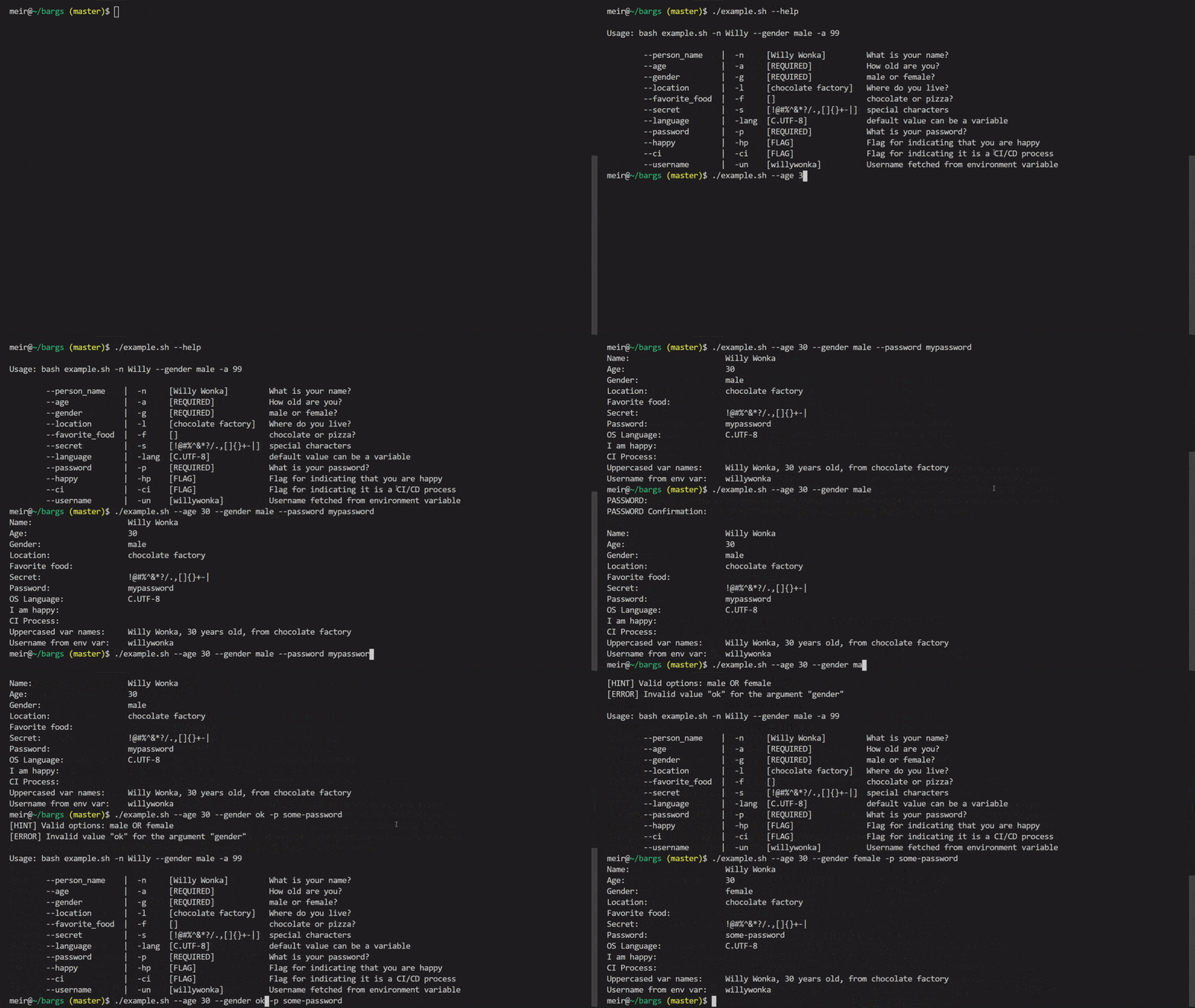
Examples
- Run the example.sh application with Docker
$ docker run --rm -it unfor19/bargs:example --help
- For more examples, take a look at the following repositories
Features
-
Help Message is auto generated, set
bargs > descriptionto update the usage (--help) message -
Short and Long Names are supported with
name=person_nameandshort=n -
Description Per Argument is supported with
description=What is your name? -
Flexible Assignment enables passing arguments with the equal sign or a whitespace
example.sh --name "Willy Wonka"example.sh --name="Willy Wonka"
-
Default Value for each argument can be set with
default=some-value
- If
defaultcontains whitespaces, use double quotes -default="Willy Wonka" - If
defaultstarts with a$, then it's a variable
default=$LANGis evaluted todefault=en_US.UTF-8
- If
-
Allow Environment Variables with
allow_env_var=true, if argument is empty then the environment variable will be used. If environment variable is empty, thedefaultwill be used
- Environment variable name must be UPPERCASED,
export USERNAME=willywonka - Available in your application as
$USERNAMEor$username
- Environment variable name must be UPPERCASED,
-
Allow Empty Values with
allow_empty=true -
Flag Argument with
flag=true, if the flag is provided, its value is true -CI=true -
Constrain Values is supported with
options=first second last, use whitespace as a separator -
Prompt for arguments with
prompt=true
- Hide user input with
hidden=true - Prompt for value confirmation with
confirmation=true
- Hide user input with
Requirements
- Bash v4.4+
- Util-Linux - We're printing beautiful stuff with the column command
macOS
brew install util-linuxUbuntu (Debian)
sudo apt-get -y update && sudo apt-get install -y bsdmainutilsAlpine
apk add --no-cache util-linux bashCentOS
yum update -y && yum install -y util-linux bashWindows
Works in Windows-Subsystem-Linux (WSL) using Ubuntu 18.04
More details - Expand/Collapse
Make sure you use dos2unix on all files, see another example here
choco install dos2unix

# ...

dos2unix bargs.sh bargs_vars example.sh tests.sh

# ...

wsl -u root -d Ubuntu-18.04 -- source example.sh
Getting Started
-
Download
bargs.sh(10 kilobytes) and thebargs_varstemplate
- Latest version (master)
curl -sL --remote-name-all bargs.link/{bargs.sh,bargs_vars}
- Specific release (v1.x.x)
curl -sL --remote-name-all bargs.link/1.1.4/{bargs.sh,bargs_vars}
- Latest version (master)
-
Reference to
bargs_vars- do one of the following
- Default behavior -
bargs.shandbargs_varsare in the same folder - Specific
bargs_varspath -export BARGS_VARS_PATH="${PWD}/path/to/my_bargs_vars", see tests.sh
- Default behavior -
-
Edit
bargs_vars- Declare arguments/variables, here are some ground rules
- The delimiter
---is required once at the beginning, and twice in the end - Characters which are not supported:
=,~,\,'," - The last variable
bargsis necessary, comments below - It's best to
sourcebargs at the top of the bash script. Do not addset -o pipefailbeforesource bargs.sh
- The delimiter
---

name=bargs                                                # DON'T TOUCH!

description=bash example.sh -n Willy --gender male -a 99  # Editable, that's the usage message

default=irrelevant                                        # DON'T TOUCH!

---

---
bargs_vars - Expand/Collpase
---

name=person_name

short=n

description=What is your name?

default="Willy Wonka"

---

name=age

short=a

description=How old are you?

prompt=true

confirmation=true

---

name=gender

short=g

description=male or female?

options=male female

prompt=true

---

name=location

short=l

description=Where do you live?

default="chocolate factory"

---

name=favorite_food

short=f

allow_empty=true

options=chocolate pizza

description=chocolate or pizza?

---

name=secret

short=s

default=!@#%^&*?/.,[]{}+-|

description=special characters

---

name=language

short=lang

default=$LANG

description=default value can be a variable

---

name=password

short=p

prompt=true

hidden=true

confirmation=true

description=What is your password?

---

name=happy

short=hp

flag=true

description=Flag for indicating that you are happy

---

name=ci

short=ci

flag=true

description=Flag for indicating it is a CI/CD process

---

name=username

short=un

allow_env_var=true

description=Username fetched from environment variable

default=willywonka

---

name=bargs

description=bash example.sh -n Willy --gender male -a 99

default=irrelevant

---

---
-
Add one of the following lines at the beginning of your application (see Usage below)
-
bargs.shis in the root folder of your project (just like in this repo)
source "${PWD}"/"$(dirname ${BASH_SOURCE[0]})"/bargs.sh "$@"
-
bargs.shis in a subfolder, for exampletools
source "${PWD}"/"$(dirname ${BASH_SOURCE[0]})"/tools/bargs.sh "$@"
-
-
The arguments are now available as environment variables, both lowercased and UPPERCASED (see Usage below)
Usage
Using the bargs_vars above in our application - example.sh
#!/bin/bash

source "${PWD}"/"$(dirname ${BASH_SOURCE[0]})"/bargs.sh "$@"


echo "

Name:                  ~ $person_name

Age:                   ~ $age

Gender:                ~ $gender

Location:              ~ $location

Favorite food:         ~ $favorite_food

Secret:                ~ $secret

Password:              ~ $password

OS Language:           ~ $language

I am happy:            ~ $happy

CI Process:            ~ $CI

Uppercased var names:  ~ $PERSON_NAME, $AGE years old, from $LOCATION

Username from env var: ~ $username " \

    | column -t -s "~"
Usage output
Results after running tests.sh - Expand/Collapse
-------------------------------------------------------

[LOG] Bargs Vars Path - Should pass

[LOG] Executing: source example.sh -a 33 --gender male -p mypassword

[LOG] Output:


Name:                     Oompa Looma

Age:                      33

Gender:                   male

Location:                 chocolate factory

Favorite food:

Secret:                   !@#%^&*?/.,[]{}+-|

Password:                 mypassword

OS Language:              C.UTF-8

I am happy:

CI Process:

Uppercased var names:     Oompa Looma, 33 years old, from chocolate factory

Username from env var:    runner


[LOG] Test passed as expected

-------------------------------------------------------

[LOG] Help Menu - Should pass

[LOG] Executing: source example.sh -h

[LOG] Output:


Usage: bash example.sh -n Willy --gender male -a 99


	--person_name    |  -n     [Willy Wonka]         What is your name?

	--age            |  -a     [REQUIRED]            How old are you?

	--gender         |  -g     [REQUIRED]            male or female?

	--location       |  -l     [chocolate factory]   Where do you live?

	--favorite_food  |  -f     []                    chocolate or pizza?

	--secret         |  -s     [!@#%^&*?/.,[]{}+-|]  special characters

	--language       |  -lang  [C.UTF-8]             default value can be a variable

	--password       |  -p     [REQUIRED]            What is your password?

	--happy          |  -hp    [FLAG]                Flag for indicating that you are happy

	--ci             |  -ci    [FLAG]                Flag for indicating it is a CI/CD process

	--username       |  -un    [willywonka]          Username fetched from environment variable


[LOG] Test passed as expected

-------------------------------------------------------

[LOG] Default Values - Should pass

[LOG] Executing: source example.sh -a 99 --gender=male -p mypassword

[LOG] Output:


Name:                     Willy Wonka

Age:                      99

Gender:                   male

Location:                 chocolate factory

Favorite food:

Secret:                   !@#%^&*?/.,[]{}+-|

Password:                 mypassword

OS Language:              C.UTF-8

I am happy:

CI Process:

Uppercased var names:     Willy Wonka, 99 years old, from chocolate factory

Username from env var:    runner


[LOG] Test passed as expected

-------------------------------------------------------

[LOG] New Values - Should pass

[LOG] Executing: source example.sh -a 23 --gender male -l=neverland -n meir -p mypassword

[LOG] Output:


Name:                     meir

Age:                      23

Gender:                   male

Location:                 neverland

Favorite food:

Secret:                   !@#%^&*?/.,[]{}+-|

Password:                 mypassword

OS Language:              C.UTF-8

I am happy:

CI Process:

Uppercased var names:     meir, 23 years old, from neverland

Username from env var:    runner


[LOG] Test passed as expected

-------------------------------------------------------

[LOG] Valid Options - Should pass

[LOG] Executing: source example.sh -a 23 --gender male -l neverland -n meir -f pizza -p=mypassword

[LOG] Output:


Name:                     meir

Age:                      23

Gender:                   male

Location:                 neverland

Favorite food:            pizza

Secret:                   !@#%^&*?/.,[]{}+-|

Password:                 mypassword

OS Language:              C.UTF-8

I am happy:

CI Process:

Uppercased var names:     meir, 23 years old, from neverland

Username from env var:    runner


[LOG] Test passed as expected

-------------------------------------------------------

[LOG] Special Characters - Should pass

[LOG] Executing: source example.sh -a 99 --gender male -s MxTZf+6KHaAQltJWipe1oVRy -p mypassword

[LOG] Output:


Name:                     Willy Wonka

Age:                      99

Gender:                   male

Location:                 chocolate factory

Favorite food:

Secret:                   MxTZf+6KHaAQltJWipe1oVRy

Password:                 mypassword

OS Language:              C.UTF-8

I am happy:

CI Process:

Uppercased var names:     Willy Wonka, 99 years old, from chocolate factory

Username from env var:    runner


[LOG] Test passed as expected

-------------------------------------------------------

[LOG] Use Flag - Should pass

[LOG] Executing: source example.sh -a 23 --gender male --happy -p mypassword -ci

[LOG] Output:


Name:                     Willy Wonka

Age:                      23

Gender:                   male

Location:                 chocolate factory

Favorite food:

Secret:                   !@#%^&*?/.,[]{}+-|

Password:                 mypassword

OS Language:              C.UTF-8

I am happy:               true

CI Process:               true

Uppercased var names:     Willy Wonka, 23 years old, from chocolate factory

Username from env var:    runner


[LOG] Test passed as expected

-------------------------------------------------------

[LOG] Empty Argument - Should fail

[LOG] Executing: source example.sh -a 99 --gender -p mypassword

[LOG] Output:


[HINT] Valid options: male OR female

[ERROR] Invalid value "-p" for the argument "gender"


Usage: bash example.sh -n Willy --gender male -a 99


	--person_name    |  -n     [Willy Wonka]         What is your name?

	--age            |  -a     [REQUIRED]            How old are you?

	--gender         |  -g     [REQUIRED]            male or female?

	--location       |  -l     [chocolate factory]   Where do you live?

	--favorite_food  |  -f     []                    chocolate or pizza?

	--secret         |  -s     [!@#%^&*?/.,[]{}+-|]  special characters

	--language       |  -lang  [C.UTF-8]             default value can be a variable

	--password       |  -p     [REQUIRED]            What is your password?

	--happy          |  -hp    [FLAG]                Flag for indicating that you are happy

	--ci             |  -ci    [FLAG]                Flag for indicating it is a CI/CD process

	--username       |  -un    [willywonka]          Username fetched from environment variable


[LOG] Test failed as expected

-------------------------------------------------------

[LOG] Unknown Argument - Should fail

[LOG] Executing: source example.sh -a 99 -u meir -p mypassword

[LOG] Output:


[ERROR] Unknown argument "-u"


Usage: bash example.sh -n Willy --gender male -a 99


	--person_name    |  -n     [Willy Wonka]         What is your name?

	--age            |  -a     [REQUIRED]            How old are you?

	--gender         |  -g     [REQUIRED]            male or female?

	--location       |  -l     [chocolate factory]   Where do you live?

	--favorite_food  |  -f     []                    chocolate or pizza?

	--secret         |  -s     [!@#%^&*?/.,[]{}+-|]  special characters

	--language       |  -lang  [C.UTF-8]             default value can be a variable

	--password       |  -p     [REQUIRED]            What is your password?

	--happy          |  -hp    [FLAG]                Flag for indicating that you are happy

	--ci             |  -ci    [FLAG]                Flag for indicating it is a CI/CD process

	--username       |  -un    [willywonka]          Username fetched from environment variable


[LOG] Test failed as expected

-------------------------------------------------------

[LOG] Invalid Options - Should fail

[LOG] Executing: source example.sh -a 23 --gender male -l neverland -n meir -f notgood -p mypassword

[LOG] Output:


[HINT] Valid options: chocolate OR pizza

[ERROR] Invalid value "notgood" for the argument "favorite_food"


Usage: bash example.sh -n Willy --gender male -a 99


	--person_name    |  -n     [Willy Wonka]         What is your name?

	--age            |  -a     [REQUIRED]            How old are you?

	--gender         |  -g     [REQUIRED]            male or female?

	--location       |  -l     [chocolate factory]   Where do you live?

	--favorite_food  |  -f     []                    chocolate or pizza?

	--secret         |  -s     [!@#%^&*?/.,[]{}+-|]  special characters

	--language       |  -lang  [C.UTF-8]             default value can be a variable

	--password       |  -p     [REQUIRED]            What is your password?

	--happy          |  -hp    [FLAG]                Flag for indicating that you are happy

	--ci             |  -ci    [FLAG]                Flag for indicating it is a CI/CD process

	--username       |  -un    [willywonka]          Username fetched from environment variable


[LOG] Test failed as expected

-------------------------------------------------------

[LOG] Missing bargs_vars - Should fail

[LOG] Executing: source example.sh -h

[LOG] Output:


[ERROR] Make sure bargs_vars is in the same folder as bargs.sh

	Another option - export BARGS_VARS_PATH="/path/to/my_bargs_vars"


[LOG] Test failed as expected
Package your application with Docker
You can use Docker to package your Bash script as a Docker image, see the following example
-
Clone this repository
-
Build the image, see Dockerfile.example, tag it
bargs:example
docker build -f Dockerfile.example -t bargs:example .
-
Run a container that is based on the image above
docker run --rm -it bargs:example -a 23 -g male
Use this repository as a template
Thinking of writing a new Bash script? Hit the Use this template button and get a fully working example of bargs, including GitHub Actions workflows.
Contributing
Report issues/questions/feature requests on the Issues section.
Pull requests are welcome! These are the steps:
- Fork this repo
- Create your feature branch from master (
git checkout -b my-new-feature) - Add the code of your new feature
- Run tests on your code, feel free to add more tests
bash tests.sh

... # All good? Move on to the next step
- Commit your remarkable changes (
git commit -am 'Added new feature') - Push to the branch (
git push --set-up-stream origin my-new-feature) - Create a new Pull Request and provide details about your changes
Authors
Created and maintained by Meir Gabay
License
This project is licensed under the MIT License - see the LICENSE file for details